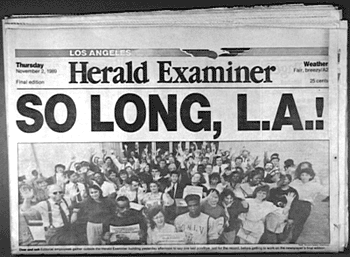
Herald Leaves a Rollicking Legacy
Journalism: Romping, stomping tales of brash paper are recalled as staff members prepare to say "30."
For the Record: A Times story Thursday on the legacy of the Los Angeles Herald Examiner incorrectly reported that a Herald editor sang the lyrics from the 1977 tune "Don't It Make My Brown Eyes Blue?" to Louella Parsons after the Hollywood columnist once mixed up the eye color of an actress. The lyrics actually came from the 1925 song "Brown Eyes--Why Are You Blue?"
By JOHN BALZAR, TIMES STAFF WRITER
They record all variety of events unfolding in every sort of place, but inevitably newspapers leave behind their own stories too.
Beneath the smudges of ink and through the yellowing pages, newspapers make their own history.
And when a newspaper passes, journalists grieve. The community--their community--is unalterably changed. And in their minds, reduced. Something romantic is lost. The civic pulse grows weaker. And reporters are tempted to hoist a stein of beer, or a shot of whiskey, or today, perhaps, a Perrier and lime. They grow melancholy and lapse into folklore.
With the Los Angeles Herald Examiner there were many good memories--funny, sad, old-fashioned, whatever--making the rounds Wednesday on the eve of its demise.
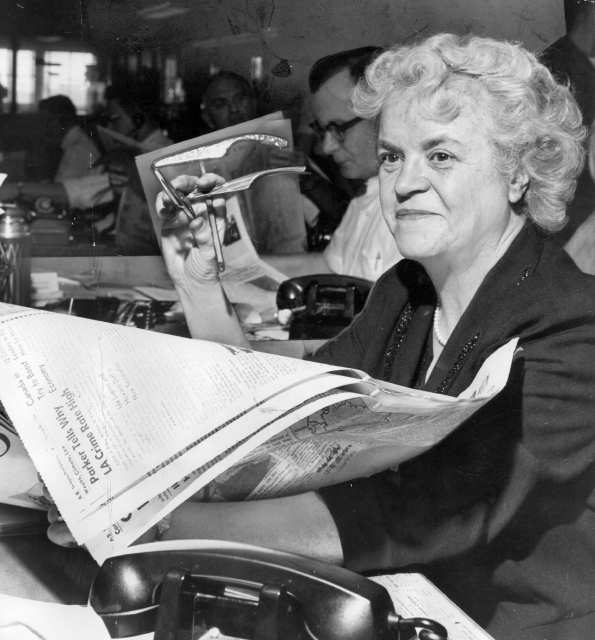
There were the romping, stomping tales from the men who worked for one of America's most colorful and remarkable women journalists, the late Agness (Aggie) Underwood. There were stories of topless bathing suits, mystery murders, a bucket of money delivered each day out the window for the bookie, an agonizing strike, of underdog journalism.
There was the sharp and indelible memory of a city room so authentic in its feel that Jack Webb created a carbon copy for the set of his hard-bitten 1959 movie, called "30." In the newsroom, "30" is typed at the bottom of a story to signify the end.
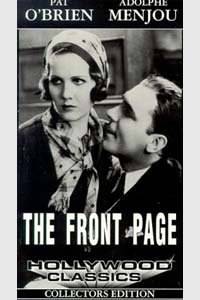
"Those were the happiest days of my life. They were rollicking, freebooting days right out of the play 'The Front Page.' Those were the last days of their kind, absolutely the last of that kind anywhere," said Frank Elmquist, 62, a star rewrite man for the Herald from 1957 to 1965.
The veterans of the Herald Express, which was combined under a single masthead in 1962 with the Examiner, recall foremost the era of a remarkable newsroom editor.
"The main story of this is Aggie Underwood," said Jack Smith, a Times columnist who worked for the Herald Express from 1949 to 1952. "She was a tough, Irish woman, sentimental. . . . She was a roughneck and loud. But she took pride in being a lady.
"She had a fantastic memory. Mickey Cohen was the big gangster of the day. She knew his home phone number. She knew the district attorney's phone number. She knew every bar in town."
Underwood was first among American women to be named the city editor of a major daily.
It's a tossup which is more remarkable--her entry into the business or her ultimate command of it.
She was the mother of two and wanted extra money for stockings, as the story is told. So Aggie became a telephone operator at a newspaper. She ended up working on a story one time when no one else was around to do the work.
From there she went on to become a celebrated crime reporter on one paper and then moved to become the crime-oriented editor of the Herald. Crime, after all, was what sold newspapers, along with sex and skulduggery."
I remember once when she was covering the murder of a waitress," Smith said. "She dropped a carnation on the body so she could call it the 'Carnation Murder' and then had her photographer take the picture. A policeman moved in and questioned her, and she said, 'Don't you dare tell me how to make a picture!'
"Naming a crime still is important in journalism. And the Herald Examiner was involved in the naming a couple of doozies.
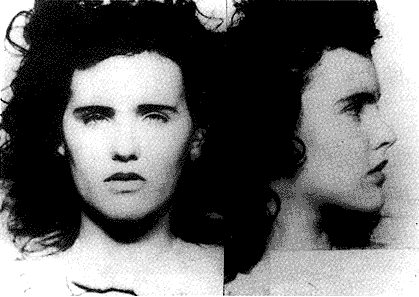
The Black Dahlia murder, the still unsolved 1947 slaying of a beautiful young woman named Elizabeth Short, got its name from a soda jerk who knew the victim. That is the recollection of Smith, who wrote the original story for a competing newspaper in what was then a multipaper market. The soda jerk said Short got the nickname because she wore her black hair in a bouffant, resembling a dahlia.
But in legend, the Herald and its writer Bevo Means get credit. They attributed the Black Dahlia to either the victim's black clothing or her lacy black underwear, depending on who is telling the story to what audience today.
More recently, the Los Angeles Police Department and the Los Angeles Times reported the savage crime spree of the "Valley Intruder." Herald Examiner editors sat in a round table until they found a more lasting name: "The Night Stalker."
Norman (Jake) Jacoby started as a police beat reporter in 1935 and still covers it from the LAPD's Parker Center. From 1952 to the infamous strike of December, 1967, he worked for the Herald.
"It was a great newspaper, and it was able to focus on the interesting aspects of stories," Jacoby remembered.
The style of the day was to send out two or three reporters to a story and then have a rewrite man or woman put their accounts together in one breathless dispatch. Sometimes, though, the journalists of the era tried individual initiative.
Elmquist recalled the year 1964, when fashion designer Rudi Gernreich "invented" the topless bathing suit.
"I knew sooner or later some gal would try to wear one," Elmquist said. "So I said, 'What happens if we make it happen?' So I got a stripper and got her in a topless bathing suit and took her down to Santa Monica beach and tried to get her arrested."
The cops, though, wouldn't touch it and, in the end, neither would the Herald.
If these were care-free, romantic days of modern journalism, they also were one-dimensional.
Minorities were virtually uncovered.
"In the black community, we didn't go down there when they got born, when they got wed or when they got killed," Elmquist acknowledged. "I don't think we were really hypocrites; we were innocents."
The journalistic triumphs of the time may seem slightly out of place today.
Times police reporter Nieson Himmel worked on the Herald from 1945 to 1967. His strongest memory? The Herald breaking the story of the explicit love letters Lana Turner wrote to Johnny Stompanato, who had been stabbed to death by Turner's daughter on Good Friday, 1958.
Himmel also recalled the Herald's willingness to have fun, like the time they opened a new men's room and celebrated with a party featuring two strippers and a baby elephant and a whole lot of other things he can no longer remember.
Robert Epstein, executive arts editor of The Times, worked at the Herald for more than 20 years. Those were the days when show business columnist Louella Parsons wielded power beyond the wildest dreams of today's journalists. Nobody was allowed to change a word of her copy. Never.
So when she described an actress as having blue eyes and the picture came in with brown, a trembling editor had to call. He sang a few bars of "Don't It Make My Brown Eyes Blue?" and then added, "Louella, this is the problem we have with your column." She relented to the change.
The strike, of course, changed the paper, its standing, the people who continued to work there and just about everything else. But not its fun-loving spirit. Creative editors like Jim Bellows and Mary Anne Dolan arrived and experimented with format and left unable to revive the underdog. Through it all, though, the style of the staff remained unchanged.
"It was an exciting place to work. There was such a small staff to cover such a large city that most reporters covered a little bit of everything. While the paper could get a little soft during the slow times, it always rose to the occasion for the big story," said Times Orange County reporter Chris Woodyard, a 1983-87 veteran of the Herald.
Linda Breakstone joined the Herald in October, 1978. On Wednesday, amid the broken hearts, she worked on tomorrow's story--her last at the paper.
"When people asked you why you worked at the Herald Examiner instead of The Times, I always answered it was the energy . . . the small victories, sometimes it was just getting the story," she said.
The bittersweet memories of Wednesday were mixed with uncertainty for many.
Sports columnist Mel Durslag started with the Herald in 1940. He is senior man there. He is one of the few with a memory of William Randolph Hearst. The two stood shoulder to shoulder in the men's room way back when and didn't say a word to each other.
With the final announcement of "30" Wednesday, Durslag was disconsolate. The years of rumors had not prepared him for the reality. Yes, he still has a part-time job at TV Guide, he said, "but I don't know what I'll do now. Maybe I should have thought about this but I didn't."
Things have happened so fast," he added. "I've been all over the world, several times. Always in good style. Next? I have no idea. I'll find a corner and sell pencils, how's that? Or I'll head out to the glue factory."
At Corky's Restaurant, a hangout for Herald staffers across the way on 11th Street, a wake for the newspaper continued late into the night. And while sentiment, and beer, flowed freely, the management kept a firm grip on reality.
"When a newspaper dies, a newspaper bar also dies," one woman at the wake said. "The waitresses tonight told us that all drinks were cash only--no tabs."
Times staff writers Myrna Oliver, Leslie Ward, Scott Harris and Edward J. Boyer also contributed to this story.
Thursday November 2, 1989
Paper's Rivals Likely Will Gain Readers, but at a Price
By JESUS SANCHEZ, TIMES STAFF WRITER
Los Angeles-area newspapers are gearing up to capture the readers and advertisers of the Los Angeles Herald Examiner, which will publish its last edition today.
But any circulation gains might be costly in the short run, say industry officials and analysts, and there will be very little Herald advertising to go around, because most of it is already carried by its competitors.
"The surviving newspapers will get some additional readers but are not going to get much incremental advertising," said J. Kendrick Noble Jr., a media industry analyst at Paine Webber Group.
Furthermore, analysts say the Herald's competitors may suffer financially in the short term because they won't be able to pass on the cost of printing additional papers to advertisers for at least six months.
"I would think there will be some costs before there are some benefits," said newspaper industry analyst John S. Reidy at Drexel Burnham Lambert.
Still, players in the hotly competitive market are not wasting any time carving up the Herald's 238,392-daily circulation and advertisers.
"We intend to beef up all three (of our newspapers) to pick up as much circulation as we can," said Thomas J. Wafer Jr., general manager of Copley Los Angeles, which owns the Outlook in Santa Monica, the Daily Breeze in Torrance and the San Pedro News Pilot. "We will be looking to beef up coverage in certain areas and pick up street sales.
"I don't want to seem cold about this thing," Wafer said. "It's a sad thing when any newspaper dies. But the readers don't automatically go to other newspapers. We lose them as newspaper readers, and we need newspaper readers."
The Long Beach Press-Telegram said it will increase the number of its news racks and might launch an advertising campaign to attract the 16,000 Herald readers in its market.
"I don't believe we would get all those readers," said Mack Quintana, senior vice president of sales and marketing of the Press-Telegram, which has a daily circulation of 128,000. "I'm sure all of us will be vying for a piece of those readers."
The Los Angeles Times said it will purchase the paper's subscription lists, some comics and syndicated features and more than 10,000 of the Herald's news racks. The Times said it might pick up at most 50,000 Herald readers.
"We hope to convert them to Times readers," said Times Publisher David Laventhol. But, he noted, "you are dealing with a relatively small pie here, and it probably won't affect the marketplace. It's sad but true."
The Herald has seen its circulation and influence dwindle since 1967, when circulation peaked at 729,000. Since then, the paper's circulation fell by nearly half a million, and it recently claimed about 8% of the 4 million households in the five-county greater Los Angeles area. The Times, by comparison, claims about 25%, according to industry estimates.
Analysts say most of the Herald's readership was concentrated in Los Angeles and was relatively insignificant in suburban areas such as Orange County. "They are spread out over the entire Los Angeles market and even beyond," said David J. Auger, publisher of the Daily News in the San Fernando Valley. But "the impact is fairly negligible in our market."
The paper's mostly blue-collar readership also did not appeal to advertisers who prefer more affluent, professional workers.
"If Hughes Aircraft had recruitment ads, the Herald would not be the place to go to if you wanted to reach someone in the aerospace industry," said Ron Lawrence, media director at the Los Angeles office of D'Arcy Masius Benton & Bowles, an advertising agency.
"It was never a must buy," Lawrence said. "We will probably look to fill the gap by going to more local papers, some of which are distributed free of charge."
Industry observers said it is unlikely that another newspaper company would come in to fill the gap left by the Herald.
Friday November 3, 1989
What the Herald's Death Means
Publishing: Many metropolitan areas are supporting more newspapers than ever. A lot of them are weeklies covering the suburbs.
By THOMAS B. ROSENSTIEL, TIMES STAFF WRITER
At first glance, the death of the Los Angeles Herald Examiner might seem an old story: another signal that American cities can no longer support two newspapers.
It sometimes seems that r